
“One who knows the Mississippi will promptly aver—not aloud, but to himself—that ten thousand River Commissions, with the mines of the world at their back, cannot tame that lawless stream, cannot curb it or confine it, cannot say to it, Go here, or Go there, and make it obey; cannot save a shore which it has sentenced; cannot bar its path with an obstruction which it will not tear down, dance over, and laugh at.” —Mark Twain, Life on the Mississippi
I first read Life on the Mississippi when I was in my early teens, and I confess that most of it sailed cleanly over my head. During high school and college, my summer jobs were spent on the river—or, I should say, on the riverbank—working for my dad’s employers: a barge line in St. Louis, and a barge fleeting/drydock company in New Orleans. Over those years, I developed a real admiration (and fear) of the Mississippi as a beautiful, powerful, dangerous, and malodorous engine of commerce. So when I saw that quote in 1993, in the aftermath of the flood that wiped out entire towns in the river’s floodplain, it stuck in my head, and I knew that I needed to re-read the book. I’ve read it at least a couple more times since then.
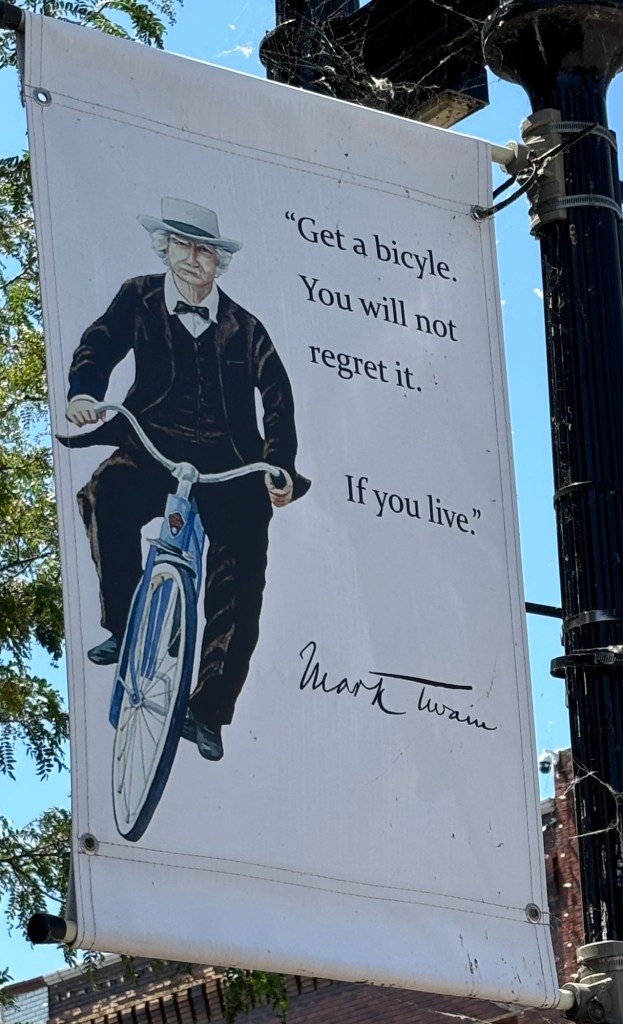
I think I first came to Hannibal on a family outing when I was 9 or 10, and then probably visited once or twice more with either Cub Scouts or Boy Scouts, but not since I was a teenager. Visiting Hannibal again for the first time in more than fifty years, and on a bicycle this time, I paid more attention to the topography and the presence of the river. It’s easy to see why that “lawless stream” figured so prominently in so many of Twain’s narratives. The river is only 500 yards from his boyhood home. It would’ve been an omnipresent, unavoidable fact of life, and Samuel Clemens decided to do what so many others did: he put the river to work. (Ironically, the Corps of Engineers continues to ignore Twain’s admonition and has erected levees and flood walls to prevent the downtown streets and historic sites from being inundated. So far, it’s working, but I think it’s working because Hannibal is the faster of the two guys running from a bear: they don’t need a barrier high enough to protect Hannibal against a 100-year flood; they just need a barrier that’s higher than the one across the river.)
Hannibal is a nice, quaint town; worth coming back and spending more time. Granted, they’re milking Twain for all he’s worth, but it’s not overpowering. And even at its most touristy, I’ll cut it a mountain of slack because it’s tourism that’s driven by books. (Granted, 90% of the people walking the streets of Hannibal today have never read anything by Mark Twain. But maybe they will now….) And not just any books, but one book in particular that helped change a nation’s thinking about race. (Looking at you, Huckleberry Finn.) I mean, given a choice between (a) a whitewashed fence, a cave, and a paddle-wheel boat, or (b) “The Hogwarts Experience at Universal Florida,” I’m coming to the banks of the Mississippi. Every. Damn. Time.
Somewhere in the multiverse, there’s a Dan McCormack who was brave enough and disciplined enough to follow his English degree into a doctoral program, and become a professor of American literature: specifically, the Gilded Age of the late 19th and early 20th centuries, the era of Twain and Whitman and Wharton and Dreiser. I mean, clearly, there are already enough Twain scholars in our corner of multiverse that my contributions would have been superfluous. But it would’ve been fun.




 Rideworthy